Mental illness and the gospel of Jesus Christ#
From a talk given at Webster Groves ward sacrament meeting approx. 2016-07-17
Introduction
Assigned to talk on “mental illness and the gospel of Jesus Christ.”
I know something about the topic, partly from my own experience as a patient, and partly because of my work. I’m a psychiatrist and neuroscientist, a professor at WU School of Medicine.
But I’m not here to give a medical lecture. I’d appreciate your prayers on my behalf as I try to speak from a gospel perspective.
I like to think of Hymn 220 as “the psychiatrist’s hymn.” The text by Susan Evans McCloud reads, in part,
2. … In the quiet heart is hidden
Sorrow that the eye can’t see. ...

3. I would be my brother’s keeper;
I would learn the healer’s art.
To the wounded and the weary
I would show a gentle heart.
I would be my brother’s keeper—
Lord, I would follow thee.
The gospel and illness
We lived with God in a state of imperfection, but without blemish. Job 38:7 “all the sons of God shouted for joy.”
There was a creation → Adam’s and Eve’s bodies and minds were perfect and healthy. Moses 3:2 tells us that after creating Adam and Eve, God said, “all things which I had made were finished, and I, God, saw that they were good.”
There was a fall → We live in a post-Edenic world.
Jesus’ Atonement is the eventual cure for all mortal maladies
In the resurrection our bodies and minds will once again be healthy
Mental illnesses collectively comprise a major burden on humanity
Suicide is the leading cause of death in young people in China (ages 15-34), and is responsible for 10% of all deaths in Americans ages 15-44.
The WHO compiles decennial summaries on death and sickness across the whole world. Think for a second about all the serious illnesses out there, those that we see all the time and all the deathly illnesses that we are blessed not to have to encounter very often in this country.
In that perspective, it’s amazing that the WHO concluded recently that about 1/3 of “years of healthy life lost due to disability” could be attributed to mental illnesses and substance abuse (see figure).1
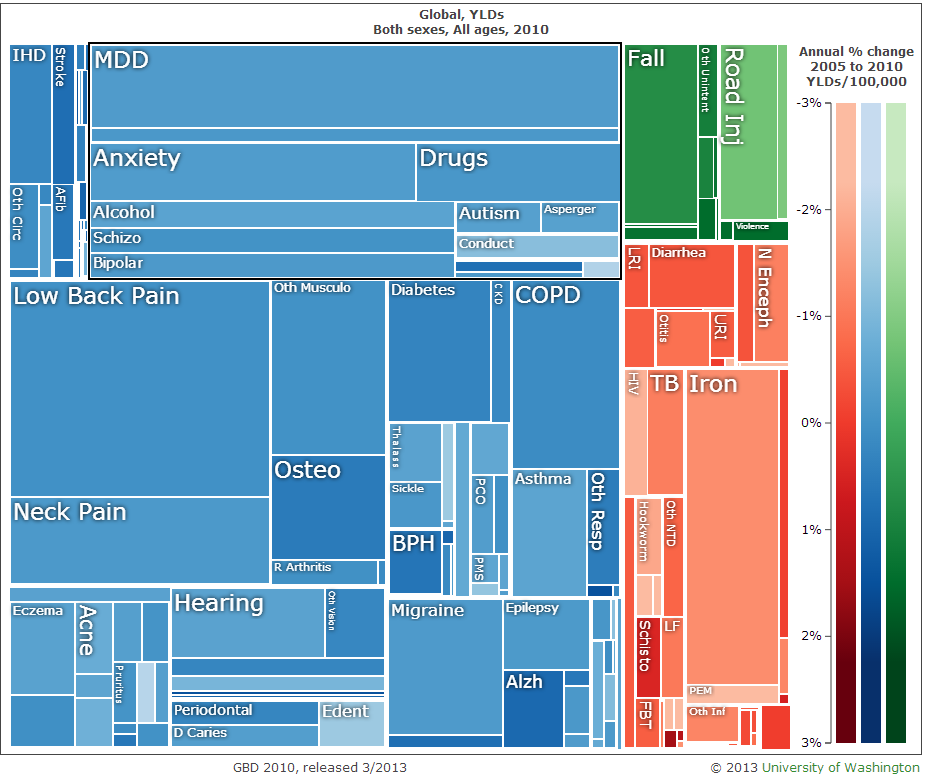
When narrowed down to specific illnesses, major depression was the second most disabling illness worldwide (Ferrari et al 2013).
What it is (what they are) – briefly, maybe categories and examples
Cognitive disorders (intellectual disability, delirium, dementia)
Autism spectrum and other developmental disorders like Tourette’s
Alcoholism and other substance abuse
Psychosis: not being able to trust your senses or your reasoning, most commonly in schizophrenia (about 1% in all cultures).
There is a something which I dread,
It is a dark, a fearful thing;
It steals along with withering tread,
Or sweeps on wild destruction’s wing.

That thought comes o’er me in the hour
Of grief, of sickness, or of sadness;
’Tis not the dread of death--’tis more,
It is the dread of madness.

– Lucretia Maria Davidson, 1825
Major depression
Not your ordinary bad day. Doesn’t get fixed by hugs or chocolate. A whole collection of symptoms, most of the day, more days that not, for weeks or months. And it feels different from ordinary sadness:
Such sensitiveness and susceptibility to mental pain is a rare occurrence where the nervous constitution is entirely normal; one seldom finds it in a healthy subject even where he is the victim of the most atrocious cruelties of outward fortune … it is positive and active anguish, a sort of psychical neuralgia wholly unknown to healthy life.” — William James
It’s pretty common. Some years ago I figured out that in a Relief Society class of 60 women, if drawn at random from the US population, about 2 to 6 have major depression now, and about 12 will have major depression at some time in their life.
Before the first really effective antidepressant treatments were discovered, about 15% of people with major depression eventually took their own life.
I have had several episodes of major depression, and they’ve had a huge, mostly negative, impact on my life. I take medicine every day to treat it.
Anxiety disorders: panic, OCD, social anxiety, phobias. Elder Alexander B. Morrison of the Seventy wrote, “Anyone who has ever witnessed the well-nigh unbearable pain of a severe panic attack knows full well that nobody would suffer that way if all that was needed was to show a little willpower.”
Sleep disorders
… and others (mania, somatoform disorders, personality disorders)
We know some things
First psychiatrist to win a Nobel prize discovered the cause and prevention of “endemic cretinism” (dietary hypothyroidism). Ditto there are now cures for syphilis and pellagra—major causes of mental illness until relatively recently—and for a number of uncommon illnesses like Wilson’s disease.
Alcoholism is common in the children of alcoholics—but biological children, not adoptive children.
The reason major depression runs in families is nearly all due to shared genes, not shared environment.
Have found several genes that, alone, can cause frontotemporal dementia.
And textbooks full of more.
Fortunately, one thing we know is that there are extremely helpful treatments of various kinds for almost all mental illnesses. Depending on the specific person and his or her symptoms, these range from psychological treatments delivered online to physical treatments including medication. Our leaders have spoken about this:
Elder Dallin H. Oaks said:
Latter-day Saints believe in applying the best available scientific knowledge and techniques. We use nutrition, exercise, and other practices to preserve health, and we enlist the help of healing practitioners, such as physicians and surgeons, to restore health. The use of medical science is not at odds with our prayers of faith and our reliance on priesthood blessings. When a person requested a priesthood blessing, Brigham Young would ask, “Have you used any remedies?” To those who said no because “we wish the Elders to lay hands upon us, and we have faith that we shall be healed,” President Young replied: “That is very inconsistent according to my faith. If we are sick, and ask the Lord to heal us, and to do all for us that is necessary to be done, according to my understanding of the Gospel of salvation, I might as well ask the Lord to cause my wheat and corn to grow, without my plowing the ground and casting in the seed. It appears consistent to me to apply every remedy that comes within the range of my knowledge, and [then] to ask my Father in Heaven … to sanctify that application to the healing of my body.” Of course we don’t wait until all other methods are exhausted before we pray in faith or give priesthood blessings for healing. … Most often we pursue all efforts simultaneously. This follows the scriptural teachings that we should “pray always” (D&C 90:24) and that all things should be done in wisdom and order. — Dallin H. Oaks, “Healing the Sick”, 4/2010 General Conference (omitting internal footnotes)
Elder Morrison wrote, “Remember that God has given us wondrous knowledge and technology that can help us overcome grievous problems such as mental illness. Just as we would not hesitate to consult a physician about medical problems such as cancer, heart disease, or diabetes, so too we should not hesitate to obtain medical and other appropriate professional assistance in dealing with mental illness.”
One treatment that doesn’t work is to tell people to just stop it. Again quoting Elder Morrison, “There are some who mistakenly believe that the mentally ill just need to ‘snap out of it, show a little backbone, and get on with life.’ Those who believe that way display a grievous lack of knowledge and compassion. The fact is that seriously mentally ill persons simply cannot, through an exercise of will, get out of the predicament they are in. They need help, encouragement, understanding, and love. … We don’t say to persons with heart disease or cancer, ‘Just grow up and get over it.’ Neither should we treat the mentally ill in such an uncompassionate and unhelpful way.”
And, although the bishop will be glad to give spiritual advice and blessings, and to address questions of sin and guilt, “We must understand,” said Elder Morrison, “that ecclesiastical leaders are spiritual leaders and not mental health professionals. Most of them lack the professional skills and training to deal effectively with deep-seated mental illnesses and are well advised to seek competent professional assistance for those in their charge who are in need of it. Remember that God has given us wondrous knowledge and technology that can help us overcome grievous problems such as mental illness. Just as we would not hesitate to consult a physician about medical problems such as cancer, heart disease, or diabetes, so too we should not hesitate to obtain medical and other appropriate professional assistance in dealing with mental illness.”
Sister Aburto: “When our minds are suffering, it is appropriate to seek help from God, from those around us, and from medical and mental health professionals.”
Elder Scott: “Healing may begin with a thoughtful bishop or stake president or a wise professional counselor. If you had a broken leg, you wouldn’t decide to fix it yourself. Serious abuse can also benefit from professional help. … Get help now. … The Lord will help you, but you must reach out for that help.”
Elder Soares re: addictions: “Additionally, you may also desire to seek the support of your family, friends, and competent medical and counseling professionals. … I testify that as we continually strive to overcome our challenges, God will bless us with the gifts of faith to be healed and of the working of miracles. He will do for us what we are not capable of doing for ourselves.”
One other thing we know that I’d especially like to point out is that religious activity is a protective factor against mental illness generally.
E.g. suicide rate is high in Utah, and, like nearly everything that makes the news from Utah, some people blame the church for it. But “the facts do not at all support the idea that ‘LDS culture’ raises the suicide rate. In fact, the facts suggest that active participation in The Church of Jesus Christ of Latter-day Saints may be a strong preventive factor in the fight against suicide” [Black, 2006]. Suicide is in fact from 2 to 5 times less common in active LDS in Utah than in other Utahns.
But observing that religion is a protective factor against mental illness, does not mean religiosity protects us completely! We all live in a fallen world. Good people have brain diseases just like they have liver diseases or need glasses. Examples:
George Albert Smith’s severe depression
Pres. Benson’s dementia
Friends of mine
These examples lead to a very important point: mental illness does not imply sin.
Recall what God told Job’s friends-qua-accusers (Job 42:7)
Remember the blind man Jesus healed after disciples asked who sinned, that he was born blind, and he answered, neither (John 9:1-3).
As an extreme example, I’ve had a few medical students ask me over the years if I thought serious mental illnesses were manifestations of demonic possession. Elder Morrison addressed this point, too, saying, “let us take care not to give the devil credit for everything that goes awry in the world! Generally speaking, the mentally ill do not need exorcism; they require treatment from skilled health-care providers and love, care, and support from everyone else.”
Matthew 4:24, “they brought unto [Jesus] all sick people that were taken with divers diseases and torments, and those which were possessed with devils, and those which were lunatic, and those that had the palsy; … and he healed them.”
Sr. Aburto: “It is important to recognize that depression is not the result of weakness, nor is it usually the result of sin.”
Other things, sadly, we don’t know yet, including how to completely cure major depression, or schizophrenia, or Tourette’s.
But there is hope!
Jesus’ Atonement is the eventual cure for all mortal maladies.
In the resurrection our bodies and minds will once again be healthy …
Alma 11: 42 … the death of Christ shall loose the bands of … death, that all shall be raised from this temporal death. 43 The spirit and the body shall be reunited again in its perfect form; both limb and joint shall be restored to its proper frame, even as we now are at this time; and we shall be brought to stand before God. … 44 … [T]his restoration shall come to all, both old and young, both bond and free, both male and female, both the wicked and the righteous; and even there shall not so much as a hair of their heads be lost; but every thing shall be restored to its perfect frame
Testimony
Psychiatrists and neuroscientists learn about all kinds of interesting things that can challenge faith.
Sometimes we as humans perceive symptoms of mental illness as spiritual phenomena (e.g. Grandma Jones’s repeated confessions, or Dostoevsky’s ecstatic seizure auras)
But I have paid special attention over the past 26 years to all of these issues, and none of them challenge my faith. I would be glad to share my thoughts on relevant questions.
There is hope for all of us who suffer from mental illness, both now in terms of emotional, spiritual and social support from the ward, and expert help from mental health professionals, and in the eternal perspective.
At the last day we can all be healed, and we can all be happy, through the Atonement of Jesus Christ. As the prophet Mormon wrote,
Mormon 7: 5 “[B]elieve in Jesus Christ, that he is the Son of God, and that he was slain by the Jews, and by the power of the Father he hath risen again, whereby he hath gained the victory over the grave; and also in him is the sting of death swallowed up.6 “And he bringeth to pass the resurrection of the dead, whereby man must be raised to stand before his judgment-seat. 7 “And he hath brought to pass the redemption of the world, whereby he that is found guiltless before him at the judgment day [through Christ’s Atonement] hath it given unto him to dwell in the presence of God in his kingdom, to sing ceaseless praises with the choirs above, unto the Father, and unto the Son, and unto the Holy Ghost, which are one God, in a state of happiness which hath no end.”
Healing–a thought from Sister Aburto:
Let us all remember that our Savior, Jesus Christ, “[has taken] upon him [our] infirmities, that his bowels may be filled with mercy, according to the flesh, that he may know … how to succor [us] according to [our] infirmities.”34 He came “to bind up the brokenhearted, … to comfort all that mourn; … to give unto them beauty for ashes, the oil of joy for mourning, the garment of praise for the spirit of heaviness.”35 I testify to you that “thru cloud and sunshine” the Lord will abide with us, our “afflictions [can be] swallowed up in the joy of Christ,”36 and “it is by grace that we are saved, after all we can do.”37 I testify that Jesus Christ will return to the earth “with healing in his wings.”38 Ultimately, He “shall wipe away all tears from [our] eyes; and there shall be no more … sorrow.”39 For all who will “come unto Christ, and be perfected in him,”40 the “sun shall no more go down; … for the Lord shall be [our] everlasting light, and the days of [our] mourning shall be ended.”41
I bear witness to the reality of that happy future in the name of Jesus Christ, amen.
Triage & suicidality#
Note 17 in sister Aburto’s talk re: getting help for suicide prevention (See Dale G. Renlund, “Understanding Suicide” (video), ChurchofJesusChrist.org; “Talking about Suicide” (video), ChurchofJesusChrist.org; Kenishi Shimokawa, “Understanding Suicide: Warning Signs and Prevention,” Ensign or Liahona, Oct. 2016, 35–39.)
References#
“Myths about Mental Illness” By Elder Alexander B. Morrison Of the Seventy, Ensign Oct., 2005, accessed 16 Jul 2016)
Ferrari AJ, Charlson FJ, Norman RE, Patten SB, Freedman G, Murray CJ, et al. (2013) Burden of Depressive Disorders by Country, Sex, Age, and Year: Findings from the Global Burden of Disease Study 2010. PLoS Med 10(11): e1001547. doi:10.1371/journal.pmed.1001547
Deaths from all causes in the US, 2000, ages 15-44: National Vital Statistics Report, vol. 50, no. 16, Sept. 16, 2002
Woodger, Mary Jane (Fall 2008). “‘Cheat the Asylum of a Victim’: George Albert Smith’s 1909-1912 Breakdown”. Journal of Mormon History 34 (4) 113-152, 2008. article at USU Digital Commons, accessed 16 Jul 2016
Relief Society estimate came from: Am J Psychiatry 163(12)2141. See also Desai HD, Jann MW: Major depression in women: A review of the literature. (Women’s health series.) J Am Pharm Assoc (Wash) 40(4):525-537, 2000. DOI: 10.1016/S0003-0465(16)34166-0, quoted in Medscape Today 01 Jul 2000
But there are excellent more recent epidemiological studies.
Black KJ: Letter to the editor: Suicide and Mormon culture (May 11, 2006). Available at https://works.bepress.com/kjb/27/ (Accessed 16 Jul 2016).
Aburto: https://www.churchofjesuschrist.org/study/general-conference/2019/10/31aburto?lang=eng
1828 Webster’s Dictionary, s.v. remedy:
REM’EDY, noun [Latin remedium; re and medeor, to heal.]
1. That which cures a disease; any medicine or application which puts an end to disease and restores health; with for; as a remedy for the gout.
2. That which counteracts an evil of any kind; with for, to or against; usually with for. Civil government is the remedy for the evils of natural liberty. What remedy can be provided for extravagance in dress? The man who shall invent an effectual remedy for intemperance, will deserve every thing from his fellow men.
3. That which cures uneasiness.
Our griefs how swift, our remedies how slow.
4. That which repairs loss or disaster; reparation.
In the death of a man there is no remedy
Additional thoughts, later#
06 June 2018#
See home/me/frank/background for lots of cool, relevant quotes from the “Love and Culpability” project
Among these is the following (boldface mine):
… President Joseph Fielding Smith explained that “all spirits while in the pre-existence were perfect in form, having all their faculties and mental powers unimpaired. … Deformities in body and mind are … physical.” (Answers to Gospel Questions, comp. Joseph Fielding Smith, Jr., 5 vols., Salt Lake City: Deseret Book Co., 1979, 3:19.) Physical means “temporal”; temporal means “temporary.” Spirits which are beautiful and innocent may be temporally restrained by physical impediments.
If healing does not come in mortal life, it will come thereafter. Just as the gorgeous monarch butterfly emerges from a chrysalis, so will spirits emerge.
“Their sleeping dust [will] be restored unto its perfect frame, bone to bone, and the sinews and the flesh upon them, the spirit and the body to be united never again to be divided, that they might receive a fulness of joy.” (D&C 138:17.)
And, “the soul shall be restored to the body, and the body to the soul; yea, and every limb and joint shall be restored to its body; yea, even a hair of the head shall not be lost; but all things shall be restored to their proper and perfect frame.” (Alma 40:23; italics added.)
“O how great the plan of our God! … The spirit and the body is restored to itself again, and all men become incorruptible, and immortal, and they are living souls, having a perfect knowledge like unto us in the flesh, save it be that our knowledge shall be perfect.” (2 Ne. 9:13.)
The Apostle Paul said: “If in this life only we have hope in Christ, we are of all men most miserable.” (1 Cor. 15:19.)
If our view is limited to mortal life, some things become unbearable because they seem so unfair and so permanent. There are doctrines which, if understood, will bring a perspective toward and a composure regarding problems which otherwise have no satisfactory explanation.
Truth: We are spirit children of a Father God. We lived with him in our premortal existence, of which it must be said that there was not, neither could there have been, a beginning. The revelations speak of things “from before the foundation of the world” and “before the world was.” (See D&C 124:33–41.)
Truth: Mortal life is temporary and, measured against eternity, infinitesimally brief. If a microscopic droplet of water should represent the length of mortal life, by comparison all the oceans on earth put together would not even begin to represent everlasting life.
Truth: After mortal death we will rise in the resurrection to an existence to which there will not, neither could there be an end. The words everlasting, never ending, eternal, forever and forever in the revelations describe both the gospel and life.
That day of healing will come. Bodies which are deformed and minds that are warped will be made perfect. In the meantime, we must look after those who wait by the pool of Bethesda. …
Boyd K. Packer, “The Moving of the Water,” Ensign, May 1991, 7
General Conference 2017:#
Pres. Uchtdorf — spiritual health#
“Sometimes it helps to talk with someone who cares about our troubles.” “When we suffer from emotional distress or mental illness, we seek … those who treat these” problems. Describes spiritual breakdowns / spiritual burnout. “We can heal spiritually” through the Savior. Spiritual ailments all involve “the loss of spiritual light”: when we’re in darkness we’re more likely to make poor choices or to feel hopeless. The more we turn to the light, the better servants we will be (and the happier etc.). Jesus said, “I am the light of the world.”
Every small step matters!
- 1
Statistics come from the World Health Organization, 2000-2011. See Ferrari et al., 2013, cited above.