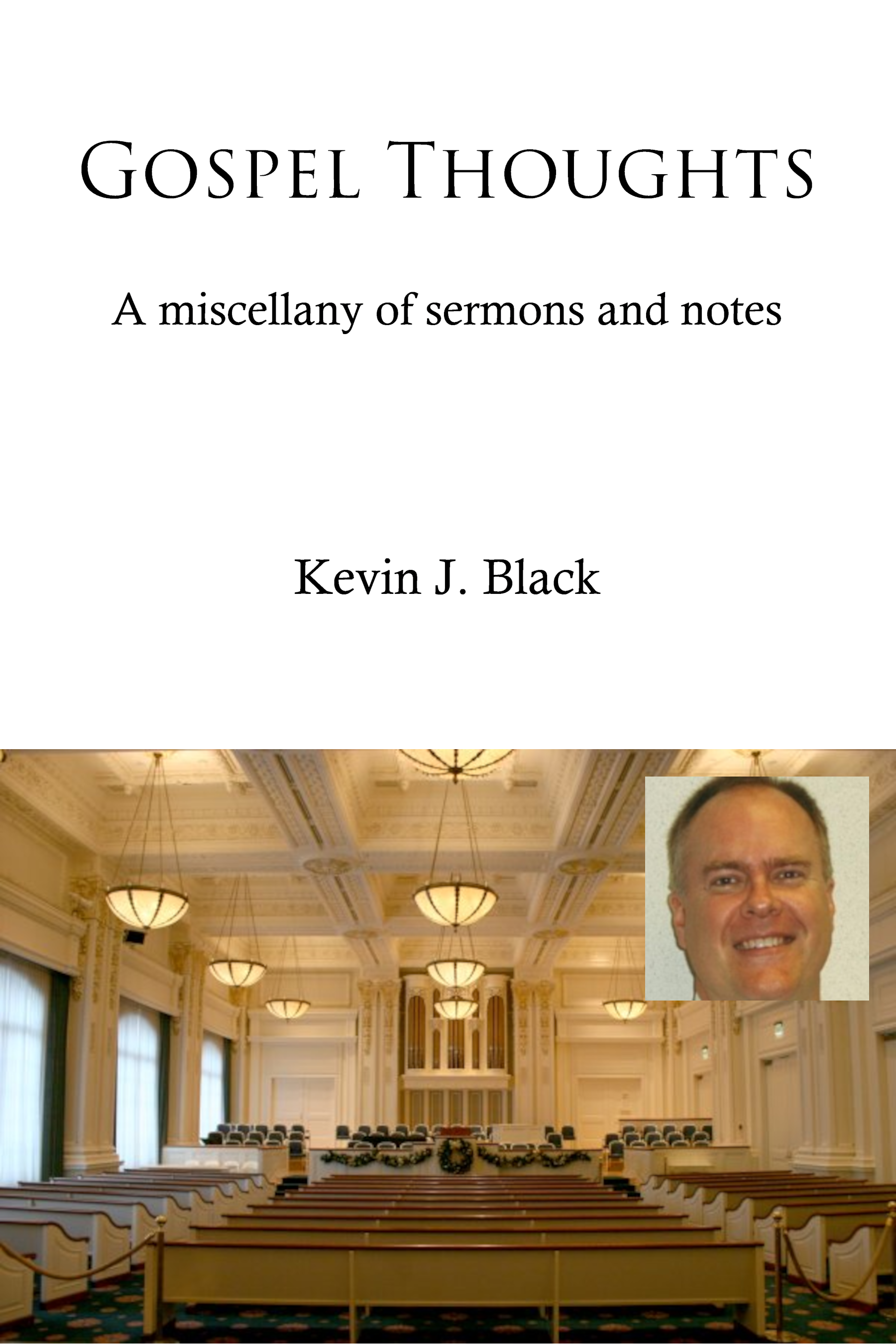
Hi. I’m Kevin.#

Who I am#
I’m a husband and dad. I take care of people with movement disorders and do brain research. I belong to The Church of Jesus Christ of Latter-day Saints.
About me#
My parents belonged to the Church, but I grew up in South Carolina so I was one of maybe 4 or 5 Latter-day Saints in my high school of 1,600 students. I was in the marching band, and on a city league swim team during the summers. I was a full-time missionary in Los Angeles and southern Brazil. When I returned, I finished college and then went to medical school. At work I am a professor at a medical school. I do brain imaging research on Tourette syndrome and Parkinson disease. I love trying to figure out how the brain works and how diseases can change our behavior. Away from work, I like to read, ride my bicycle, and spend time with my wife and children.
Why I belong to the Church#
I believe this is Jesus’ modern church. I really do. That’s what it comes down to. I believe God is real. I believe He is our Father in Heaven and loves us. I believe He knows more than we do. I believe He wants us to know how to live in a way that makes us better and happier people, and makes society better too. I believe that God gave us prophets to address those very goals.
That’s what I believe, but why do I believe it? There are reasons of the head and of the heart. I have read the Bible through. I’ve read the New Testament and the Book of Mormon many times. I’ve read much of what the leaders of the Church have said over the past 180 years. I believe that the teachings of the modern Church of Jesus Christ accord with and amplify the teachings of the New Testament. Also, like one of the Book of Mormon prophets, “I have fasted and prayed many days that I might know these things of myself. And now I do know of myself that they are true; for the Lord God hath made them manifest unto me by his Holy Spirit.”1 It’s hard to describe what it is like to feel the Holy Spirit, but for me it includes a sense of peace, sweetness, and clarity of thought. How do I know that isn’t just wishful thinking? Faith plays a role, but also if something really is from God, I think it should make me a better person, help me understand life and truth better, and make me happy.2 The things I learn at Church do all that.
I want to say just a word about religion and science. I am aware of numerous areas in which scientific information has challenged religious faith. As a neuroscientist and neuropsychiatrist, I know about some of these in great detail. However, I do not see any ultimate conflict between science and the teachings of the Church of Jesus Christ of Latter-day Saints. Our religion can embrace anything true. In fact, Latter-day Saints are taught that “the glory of God is intelligence,”3 and we believe the Lord commanded us to learn about “things both in heaven and in the earth.”4 There are things I don’t understand yet, but that is part of faith: having patience to give our Heavenly Father a chance to explain things to us on His own timetable.
How I live my faith#
That’s a big question. It’s awkward to answer, because I am so far from getting it all right. But I can say that the gospel has made me a much better person than I would have been otherwise. I guess I see my Christian discipleship in two parts. One is stuff I do. The other, and probably the more important part, is who I am trying to become.
The “stuff I do” includes public things, like going to Church or accepting calls to serve in Church assignments. I spend about 3 hours a week at church as an ordinary member, plus there’s shuttling kids to youth activities or early morning seminary (Bible study class). My current calling (~2011) primarily involves training Church leaders in the area.5 It probably takes an additional 6 hours a week, or more. I also am assigned to visit 5 families from our congregation in their homes every month, to give a short lesson and make sure they are OK. The “stuff I do” also includes family devotional time every week, and personal scripture study.
Now the part about becoming. I think, like many people in the world, I sincerely try to become a better person, to notice my weaknesses and ask the Lord’s help in overcoming them. This is about being a better son and husband and father and doctor and manager and neighbor, and even about being nice to obnoxious drivers on the way to work. I am very grateful for the lessons at church that remind me of things I need to work on. I also feel that the callings to serve in the Church help my personal spiritual development, because when you undertake to do the Lord’s work, you know you have to try to get closer to Him in order for Him to guide you.
“Can you think of a specific challenge in your family that gospel principles helped overcome?”#
Several years ago my wife and I started feeling like we should have another child. However, we had been happy with our family size, we worried about the additional stress, and we were concerned about the risk of Down syndrome (about 1 in 65 at our age). We prayed often to know what God wanted us to do. Finally we both felt that He did want us to have another child, and that either she would not have Down syndrome or the Lord would somehow help us handle it.
In the course of prenatal care, we found out that we were having a girl with Down syndrome. This was difficult news for us. Our obstetrician repeatedly asked if we wouldn’t prefer an abortion. It helped that we had made that decision long ago. We were very grateful for the teachings of modern apostles and prophets on how precious each human life is to our Creator.
Our children surprised us with the maturity of their responses. Within minutes of hearing the news, one of our teen daughters wisely said, “We probably need this. We have been too likely to judge people based on their intellect.” I know that was true for me personally. All the children agreed to pitch in. We also found wonderful support and advice from friends, colleagues, and the Down Syndrome Association. Still, we worried about our new daughter and about the effects her birth would have on our older children and on us. We worried about whether we would love her as much as we hoped we would and knew we should.
Our daughter is now a toddler. By her second birthday she still couldn’t walk, and it took a very long time before we could communicate with her about her basic wants. There have been frustrations and changes to our life plans. But she has been a great joy in our lives. She makes friends with people everywhere we go. Her constant love has been a real blessing for us, especially for her teenage brother. We have made new friends with her team of therapists. I am learning how valuable everyone is regardless of their cognitive ability. And I love her.
What do Latter-day Saints believe concerning the doctrine of grace?#
We absolutely believe that the only way to heaven is through the gift of our Savior, Jesus Christ. No one can earn his or her way to heaven. We are not saved by our works. We are saved by our faith in Jesus Christ, by His grace. However, we believe that faith in Jesus Christ requires more than lip service. We believe that the kind of faith that can transform a human soul is “faith unto repentance”6—in other words, faith that moves us to do what Jesus asks us to do.7
This meaning of faith makes sense in ordinary life: if I say “I totally believe you will give me a $1,000 bonus if I show up 5 minutes early to work,” but then I make no effort to get to work early, obviously I don’t really believe that! It also makes sense to me theologically, because we believe God created us as His children, not as puppets. He wants us to become more like Him, and that means we have to choose to start acting the way He acts and thinking the way He thinks.
So real faith motivates us to action. Jesus Christ has commanded everyone to repent—to stop doing bad things.8 His apostles preached the same message.9 Obviously we humans can’t fully comply with that charge during this life, but with the Lord’s help we can succeed one step at a time. He has also commanded us to receive ordinances (sacred rites) such as baptism.10 These outward works are not sufficient to save us, but they are necessary because God said so.11
What are Latter-day Saint women like? Do Mormons believe in equality of men and women?#
Women in the Church are incredibly diverse, as you might expect in a worldwide organization. I’ll give you one example.
My wife is one of the coolest people I know. She finished college by her 20th birthday, she has a master’s degree in mathematics, she’s studied German and Spanish and ASL, she knows the Bible backwards and forwards, she volunteers with the BSA and with the kids’ schools, she manages a busy house, and she generally gets more done before noon than most people get done in a week.
We believe that men and women are equally important in God’s eyes. However, our ultimate celestial reward comes not individually but in pairs. Even God is not alone, a topic reviewed by the Church in a recent essay,12 but anticipated in the earliest scripture: “God created man in his own image, in the image of God created he him; male and female created he them.”13 One of our church leaders noted that God did not consider the creation complete until He had formed woman: “Eve became God’s final creation, the grand summation of all of the marvelous work that had gone before. … In His grand design, when God first created man, He created a duality of the sexes. The ennobling expression of that duality is found in marriage. One individual is complementary to the other. As Paul stated, ‘Neither is the man without the woman, neither the woman without the man, in the Lord’ (1 Cor. 11:11).”14 He continued, “Every woman is a daughter of God. You cannot offend her without offending Him.”
In a marriage, both partners are equally important, and marriage should bless both partners. I like this quote about Adam and Eve, from one of our modern church leaders: “She was not taken from his head to stand over him, nor from his breast to go before him, nor from his back to walk behind him, nor from his foot to be trodden upon. She was taken symbolically from his side—close to his heart to stand by him as a noble companion.”15 An official statement of Church doctrine teaches that in their “sacred responsibilities, fathers and mothers are obligated to help one another as equal partners.”16
What do Latter-day Saints believe about medical ethics issues?#
I discuss this question elsewhere, after briefly summarizing Latter-day Saint beliefs and giving a few statistics on the church.17
- 1
- 2
Compare Alma 32:28.
- 3
- 4
- 5
This entire document is edited 2021-07-27 from the original document written probably around 2011, but some information is still out of date.
- 6
- 7
John the Baptist taught a similar message (Matt. 3:8).
- 8
- 9
- 10
- 11
3 Nephi 11:31,33–35,37–39; Doct. & Cov. 33:11–12, 19:31, 39:1,5–6,
- 12
- 13
- 14
Gordon B. Hinckley, “The Women in our Lives,” 2004.
- 15
Theodore M. Burton, “A Marriage to Last through Eternity,” Ensign, June, 1987, 12 (probably paraphrasing an older source such as Matthew Henry, Exposition of the Old and New Testaments, 1708–1710, volume 1, commentary on Genesis 2:21-25).
- 16
The First Presidency and Council of the Twelve Apostles of The Church of Jesus Christ of Latter-day Saints, “The Family: A Proclamation to the World,” 1995 (emphasis added).
- 17
Kevin J. Black, “Medical and ethical issues and Latter-day Saints,” 2021. https://works.bepress.com/kjb/26/